A bottle of Mouton Rothschild, reimagined each year by a different artist since 1945; an Absolut bottle transformed into a canvas by Andy Warhol; a Parisian glass roof adorned by a visual artist to accompany a gin-themed event. For a century, wine and spirits houses have been among the economic players most committed to contemporary art—and this is far from a coincidence.
At Studio Artera, an agency specializing in collaborations between contemporary artists and brands, we regularly assist wine and spirits companies in developing their artistic projects. Here’s why this highly specialized sector has turned art into a powerful brand-building tool.
Before going through the examples, it’s important to understand why this particular sector has embraced contemporary art to such a great extent—far more than most other industries. Three reasons consistently come up among the companies we work with.
The first has to do with the long term. A wine develops over several years; a cognac or whiskey, sometimes over several decades. This sense of time aligns with that of artistic creation, where a work is also built over time, far removed from the immediacy of advertising. The second reason relates to craftsmanship: winemakers, cellar masters, and master blenders claim a legacy of exceptional craftsmanship that contemporary art legitimizes and brings to life, without ever competing with it. Finally, the third reason is both economic and symbolic: the bottle is, by its very nature, a collectible item—produced in limited editions, vintage-specific, and collected. It therefore naturally lends itself to the same language as prints or artist’s multiples, which explains why the wine label has historically become one of the very first mediums for collaboration between a brand and an artist.
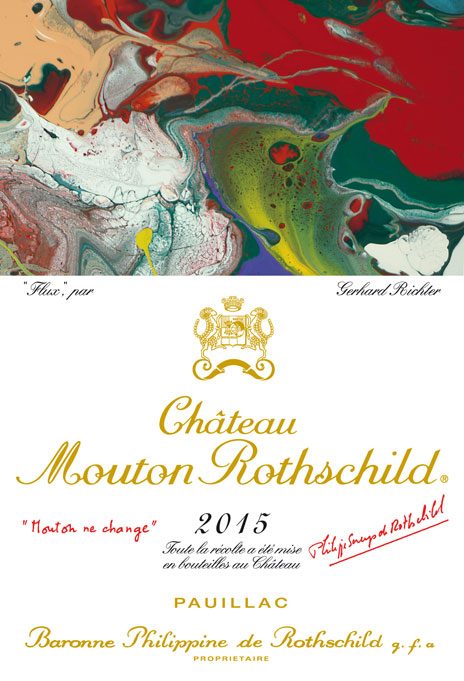
The seminal—and best-documented—example remains that of Château Mouton Rothschild. In 1924, Baron Philippe de Rothschild commissioned the Cubist poster artist Jean Carlu to design the label for the first bottling carried out directly at the château. The initiative was ahead of its time and was not immediately repeated. It wasn’t until 1945 that a second initiative firmly established the practice: to celebrate the Allied victory, the baron asked artist Philippe Jullian to draw a “V” on the vintage’s label. Since then, each year, a different artist has freely reinterpreted the Grand Cru label: Braque, Cocteau, Chagall, Miró, Dalí, Picasso, Bacon, Balthus, and more recently Jeff Koons, Gerhard Richter, Olafur Eliasson, and Joana Vasconcelos.
What this project pioneered—almost by accident—is a model that has since been adopted in virtually all wine and spirits collaborations: a different artist for each edition, total creative freedom for each participant, and a product that gains collectible value over time rather than going out of style.
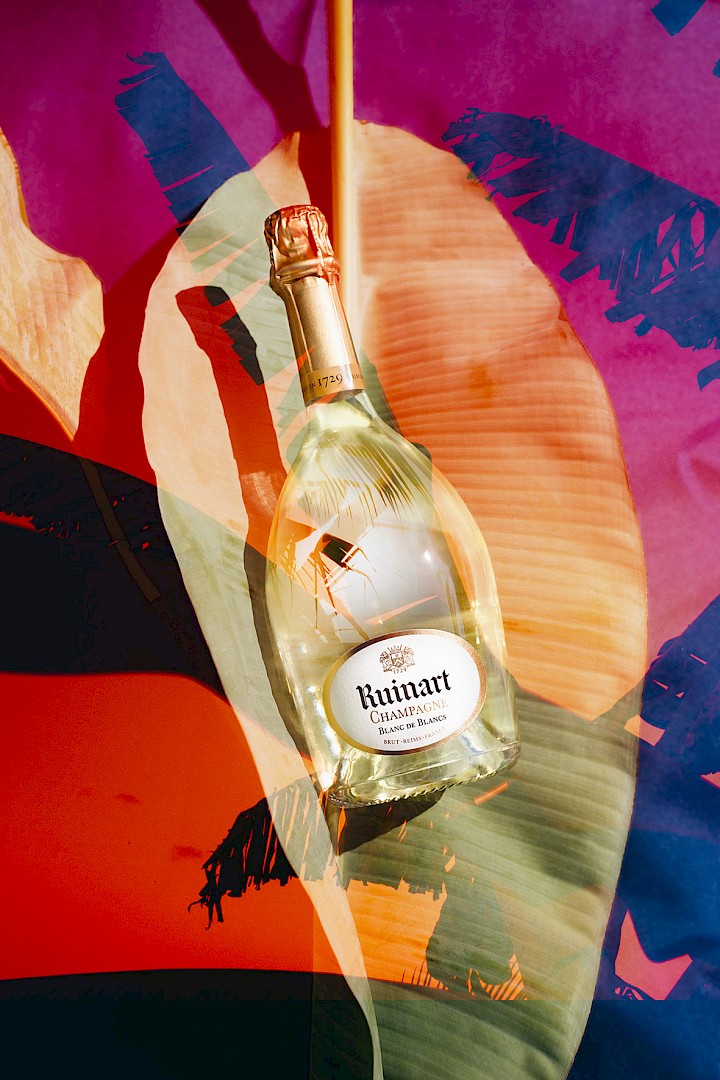
As the oldest Champagne house, founded in 1729, Ruinart takes this concept even further by making art a central pillar of its communications rather than just a one-off campaign. It all began in 1896, when the house commissioned a young, then-unknown Czech artist, Alphonse Mucha, to create its very first advertising poster—one of the first advertisements ever produced for a Champagne house. The poster caused a sensation and helped establish Mucha as a pioneer of Art Nouveau.
Since 2008, Ruinart has continued this tradition by granting “Carte Blanche” each year to a renowned contemporary artist, who is invited to take up residence in Reims to immerse themselves in the house’s vineyards and Gallo-Roman chalk cellars, designated as a UNESCO World Heritage Site. David Shrigley, Vik Muniz, Liu Bolin, and Jeppe Hein are among the artists who have participated in the program, each offering their own vision of vineyard work and champagne production, which is then exhibited at major international art fairs such as Art Basel and Frieze London. In 2018, the house took things a step further by creating the Maison Ruinart Prize, with the support of the Picto Foundation, which annually honors an emerging photographer through an artist residency in Reims, with the results previewed at Paris Photo. The second edition of this prize, in 2019, honored photographer Elsa Leydier—an artist represented by Studio Artera—who was invited to a residency in Reims during the grape harvest to capture her vision of the connection between nature and the men and women who tend the vineyards. The house subsequently commissioned her to create a series of photographs featuring its iconic cuvée.
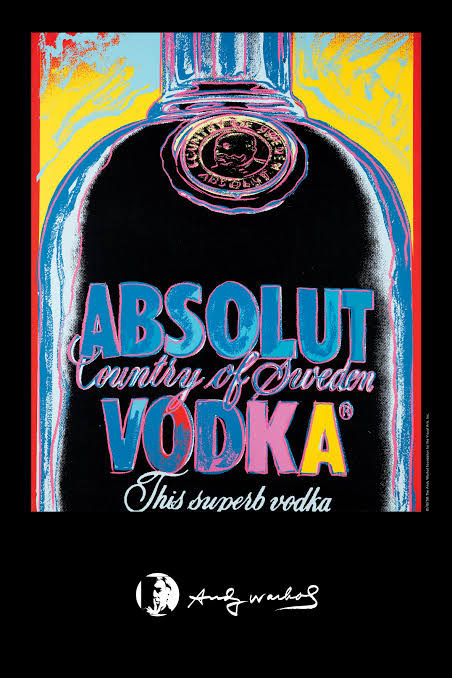
It was at Studio 54 that Andy Warhol is said to have spotted the distinctive silhouette of the Absolut Vodka bottle and suggested to its American importer, Michel Roux, that they “do something” with it. This encounter led to the creation of the painting *Absolut Warhol* in 1985, followed in 1986 by a structured program: the Swedish brand began commissioning artists to create works based on the silhouette of its bottle. Over the following decades, this initiative would result in more than 800 works and involve hundreds of emerging and established artists, making Absolut one of the very first spirits brands to transform its bottle into a recurring artistic medium rather than merely a one-off graphic design.
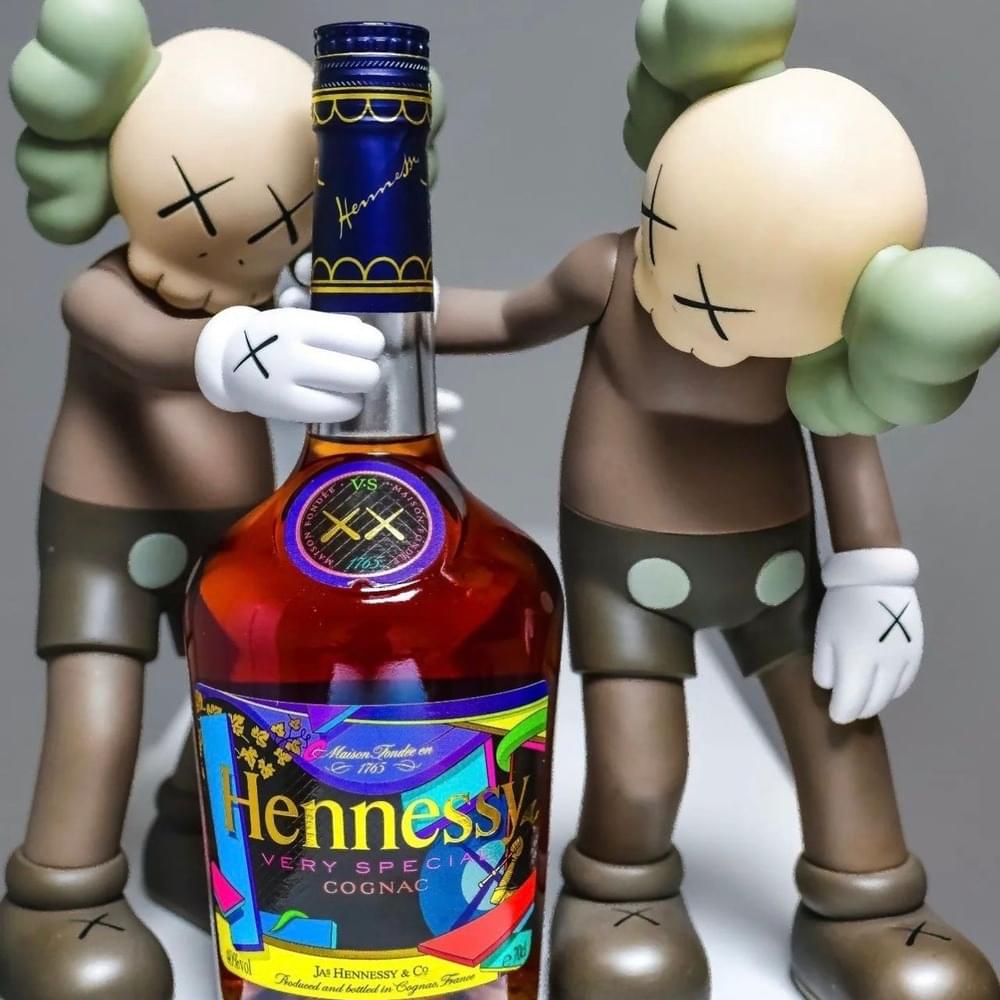
In 2011, Hennessy launched its very first custom collaboration centered on its Very Special cognac, giving New York artist KAWS free rein to reinterpret the bottle’s historic label. KAWS incorporated his signature graphic figures along with the handwritten phrase “Friends, work, music, art, it’s important to find the right blend.” The collaboration marked the beginning of an annual program that continues to this day, inviting a different artist from the urban and graffiti scenes each year to reinterpret the iconic bottle: Shepard Fairey, Os Gemeos, Futura 2000, JonOne, Vhils, and, in 2020, Faith XLVII—the first woman and the first South African artist to join the series. The concept remains the same from one edition to the next: the artist is given complete creative freedom and is invited to filter the brand’s heritage and expertise through their own graphic vision.
.jpg)
Not all wine and spirits collaborations take the form of a bottle. Some choose the retail space and the customer experience as their canvas, and that’s exactly what Bombay Sapphire did with its “Saw This Made This” campaign, launched this fall during Paris Design Week. Rather than redesigning its label, the gin brand partnered with The Hoxton hotels to transform their lobbies into spaces for temporary artistic expression.
The Hox Gallery has carefully selected artists to highlight the iconic neighborhoods where the chain’s hotels are located: Rome, Amsterdam, Barcelona, London, and Paris. Their mission was to transform the ordinary into the extraordinary through unique, ephemeral installations, each imbued with the essence and spirit of its local environment. In Paris, artist Caroline Derveaux was entrusted with the most spectacular piece in the exhibition: a monumental work displayed on the glass roof of The Hoxton hotel, visible for an entire month. Bathed in natural light, the work reveals a new chromatic detail at every hour of the day, transforming the lobby into a truly immersive space for every visitor.
Collaboration truly comes into its own in the way it connects the artwork to the product without ever subordinating the former to the latter. To complement the installation, the teams at Bombay Sapphire and The Hoxton have created a limited-edition cocktail, the “Palais Carré,” conceived as a liquid reflection of Caroline Derveaux’s artwork. Art, space, and product thus tell a single story, rather than simply coexisting side by side.
Looking back on this century of collaborations, four constants emerge, regardless of the format chosen.
First and foremost, the artist’s creative freedom is never negotiable: from Mouton Rothschild to Hennessy x KAWS, each collaboration is based on genuine creative freedom granted to the artist, not merely on a visual interpretation of a pre-written marketing brief. Second, consistency builds value: a one-off collaboration makes for a good PR stunt, but it is a long-term program—such as Mouton Rothschild since 1945, Ruinart since 2008, Absolut since 1986, or Hennessy since 2011—that builds a true brand asset. Next, the format is chosen based on the objective, not the other way around: whether it’s a label, an artist-in-residence program, or an installation at a specific location, each brand mentioned here has adapted the format of its collaboration to its own unique identity rather than replicating a generic model. Finally, the object does not need to be sold to have value: Caroline Derveaux’s work for Bombay Sapphire never resulted in a direct sale, yet it generated visibility and brand equity that a traditional advertising campaign would not have achieved.
At Studio Artera, we draw on this history to develop projects tailored to today’s wine and spirits houses: sourcing artists whose styles align with the brand’s identity and terroir, establishing the legal and creative framework for the partnership, producing the artwork or limited edition, and activating the project at a venue or point of sale. In particular, we have partnered with Bombay Sapphire, The Hoxton, and artist Caroline Derveaux to design their Paris-based collaboration, and we work with nearly 20 represented artists, each with diverse artistic visions and mediums.
The formats we produce are as varied as the history of this sector itself: a limited-edition label, a monumental installation in a retail space, an artist-in-residence program, a permanent artwork. What remains constant from one project to the next is the conviction that has run through this entire narrative for a century: a successful collaboration arises from an encounter between a publishing house and an artist, not from a commission.
Are you interested in creating your own artistic collaboration for your wine or spirits company?
👉 Check out our brand and corporate projects
👉 Discover the artists we represent
👉 Let's discuss your project
Three reasons are most frequently cited: the lengthy process of crafting a wine or spirit parallels that of artistic creation; the artisanal expertise of these houses finds natural validation in art; and the bottle—produced in limited editions and labeled with a vintage—lends itself to the same language as an artist’s multiple.
The oldest and best-documented example is that of Château Mouton Rothschild, which commissioned poster artist Jean Carlu as early as 1924 to design its label, before establishing the practice on a permanent basis starting in 1945 with artist Philippe Jullian.
Since 2008, the Ruinart Champagne House has given a “Carte Blanche” each year to a contemporary artist, who is invited to take up residence in Reims to reinterpret the house’s heritage. The Maison Ruinart Prize, established in 2018, was awarded in 2019 to photographer Elsa Leydier, an artist represented by Studio Artera.
As part of its “Saw This Made This” campaign and Paris Design Week, Bombay Sapphire partnered with The Hoxton hotels to commission artists to highlight the neighborhoods where the hotels are located. In Paris, artist Caroline Derveaux created a monumental work on the hotel’s glass roof, accompanied by a limited-edition cocktail designed to echo her work.
No. While the label remains the traditional format, brands such as Ruinart—with its annual “Carte Blanche” residency—and Bombay Sapphire—with its site-specific installation—demonstrate that collaboration can also take the form of a residency, an installation, or an experience, without ever resulting in a product for sale.
Specialized agencies such as Studio Artera assist wine and spirits companies with artist sourcing, creative and legal structuring, and the production of bespoke collaborations, such as the Bombay Sapphire x The Hoxton x Caroline Derveaux collaboration.


