There are places we sometimes pass by without even noticing them.
The Chapelle Expiatoire, a Historic Monument managed by the Centre des monuments nationaux and located in Paris’s 8th arrondissement, is one such example. It has stood there for two centuries, just a few meters from Boulevard Haussmann, and most Parisians who walk past it every day are unaware of its existence. Built between 1816 and 1826 on the site where Louis XVI and Marie Antoinette were temporarily buried before their transfer to the Basilica of Saint-Denis in 1815, it carries a historical and commemorative significance that its apparent urban discretion renders almost invisible.
On June 6, 2026, during Nuit Blanche, it opened its doors in a different way.
Studio Artera presented "Threshold," a light and sound installation by Emilio Ferro created specifically for this venue, and between 7 p.m. and midnight, more than 1,000 people crossed the threshold of this unique space.

At the heart of Emilio Ferro’s work lies a question that might be phrased as follows: what does a space make of what it has experienced? Not what it says about it—walls do not speak, of course—but what it retains, in an invisible, physical, imperceptible way.
The Chapel of Atonement is one of the most historically significant sites in Paris. Built during the Restoration by architect Pierre-François-Léonard Fontaine at the request of Louis XVIII, it marks the site of a former cemetery where hundreds of victims of the revolutionary days were buried, as well as the royal remains before their transfer to Saint-Denis. That weight isn’t something you can read on a plaque. You feel it—or rather, you (almost) don’t feel it—because most of the time, few people walk through its doors.
Threshold was born out of this tension.
Emilio Ferro has created a work that does not seek to illustrate the history of the site, nor to comment on it. It seeks to make that history perceptible: a massive beam of white light cutting across the nave of the crypt up to the vault, accompanied by a sound composition built from the frequencies of magnetic fields. These magnetic fields, which physics tells us are present everywhere, passing through stones as well as bodies, become something we can hear—almost touch—on the evening of June 6. What was there but invisible finally takes shape.
The title, *Threshold*, says exactly that.
The work is not in the nave; it is in the passageway, in the act of crossing over.
Born in Italy in 1988, Emilio Ferro has established himself as one of the most distinctive artists in the field of monumental light installations. His work exists at the intersection of mysticism and science, in that strange space where what we feel transcends what we can explain.
In 2022, he became the first artist in the world to present a light installation at the foot of the Pyramids of Giza, a work designed to engage in dialogue with one of the most profoundly symbolic monuments humanity has ever created. In 2024, After Pangea resonated at the site of the Library of Alexandria, another place symbolic of collective memory and lost knowledge. These two milestones speak to his approach: Ferro does not seek just any space. He seeks out places that have stood the test of time and that carry within them something that is still alive.
The Chapel of Atonement embodies this logic with almost self-evident precision. It is a place of remembrance, of mourning, and also of a certain form of invisibility. Few spaces in France hold as much historical significance within such a small architectural volume. For Threshold, Ferro worked closely with Studio Artera and the CMN, adapting his approach to the specific constraints of a listed building—technical, lighting, and acoustic constraints—without ever being constrained by them. The work was conceived specifically for this site, rather than transposed from another context.
Perhaps this is what sets Threshold apart from an ordinary light installation: it does not merely adorn the space, but challenges it.

Since its inception in Paris in 2002, Nuit Blanche has been one of the few cultural events capable of attracting audiences who do not typically visit art institutions. Free, held at night, and short-lived, it creates opportunities for access that traditional formats do not allow.
Choosing the Chapelle Expiatoire as the venue for Threshold meant taking that approach to its logical conclusion. Not an exhibition hall, not a converted contemporary space, but a historic monument that is usually closed at night—and yet, on that particular evening, it opened its doors.
The turnout exceeded expectations: more than 1,000 visitors in five hours, a line that stretched throughout the evening, and an audience of rare diversity. Families with children, groups of students, art lovers, curious locals, and tourists drawn by the light visible from the street. Many had never heard of the Chapelle Expiatoire before walking through its doors.
This is exactly the kind of shift that public art can bring about: not bringing art to people, but drawing people to places they wouldn’t otherwise have visited, and giving them a reason to stop there, stay a while, take something away from the experience, and perhaps even return later.
Producing Threshold kept Studio Artera busy for several months. Our relationship with the Centre des monuments nationaux, an institutional partner with whom we had previously collaborated, was central to the project from the very beginning. It was this mutual trust that made it possible to gain access to a venue of this nature under such specific installation conditions.
Our role was to ensure the project’s consistency at every stage: identifying the venue, connecting with Emilio Ferro, coordinating technical production, managing outreach and communication, and overseeing the event’s logistics. Between the initial brief and the evening of June 6, Threshold underwent dozens of revisions, adaptations, and technical challenges that were resolved.
What the audience experienced that evening—that beam of white light in a nave they may have been seeing for the first time—is the visible result of this work. The invisible architecture that underpins it is what we do.
We believe that historic sites need contemporary art just as much as contemporary art needs these sites.
One gives the other a reason to exist, and Threshold is a prime example of this.
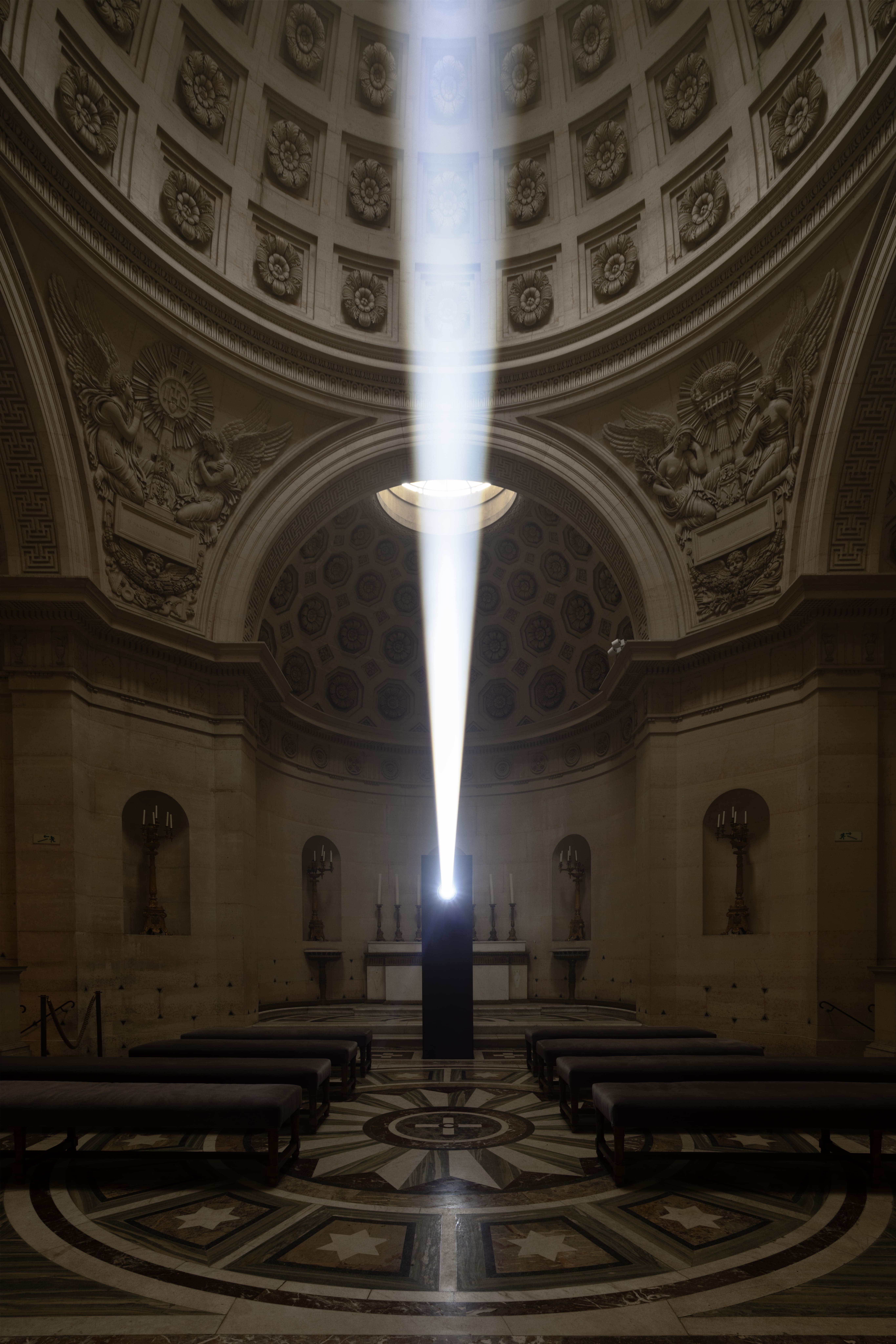
"Threshold" is a light and sound installation by artist Emilio Ferro, presented at the Chapelle Expiatoire in Paris on June 6, 2026, as part of Nuit Blanche. The work creates a dialogue between a massive beam of white light traversing the nave and a sound composition built from magnetic field frequencies.
Emilio Ferro is an Italian artist born in 1988, known for his monumental light installations designed to interact with historic sites. Notable works include the first light installation at the foot of the Pyramids of Giza (2022) and *After Pangea* at the Bibliotheca Alexandrina (2024).
The Chapelle Expiatoire is a Historic Monument managed by the Centre des monuments nationaux (CMN), located in Paris’s 8th arrondissement. Built between 1816 and 1826, it marks the spot where Louis XVI and Marie Antoinette were temporarily buried before being transferred to the Basilica of Saint-Denis in 1815.
More than 1,000 visitors explored the free exhibition during Nuit Blanche 2026, between 7 p.m. and midnight on June 6, 2026.
Studio Artera handled the entire production of the project, from establishing contact with the artist and the CMN to the technical and logistical coordination of the event, as well as the communication strategy and cultural outreach.
Threshold was an installation created for Nuit Blanche 2026 and is no longer on view in public spaces. To learn more about upcoming installations by Studio Artera or Emilio Ferro, we invite you to subscribe to our newsletter.
Studio Artera works with brands, companies, and institutions to design and produce artistic projects in public and heritage spaces. To discuss a project, please contact us directly.
👉 To learn more about our public art projects or get in touch with the Studio Artera team, click here
👉 Explore all ourpublic art projects


