A bottle of wine signed by Picasso, a century-old monogram reimagined by a Japanese artist who became an overnight sensation, a race car transformed into a rolling canvas by an American sculptor. These are not isolated anecdotes but rather the milestones of a specific story—made up of dates, encounters, and (sometimes) risky gambles—that has gradually redrawn the line between creativity and business.
At Studio Artera, an agency specializing in collaborations between contemporary artists and brands, we believe that understanding this history is the best way to shape its future. Here is a well-sourced, chronological account of how art and brands have learned to work together.
Long before the term “artist-brand collaboration” even existed, some houses already sensed that a work of art could drive sales—and, above all, that it could ensure longevity. The example most often cited by experts on the subject remains that of Château Mouton Rothschild, a case that is almost seminal in that it unwittingly set the rules of the game for an entire century.
It all began in 1924, when Baron Philippe de Rothschild commissioned the Cubist poster artist Jean Carlu to design the label for the first bottling carried out directly at the château. The idea came too soon: it would not be repeated immediately. It wasn’t until 1945 that a second, even more symbolic gesture firmly established the practice. That year, to celebrate the Allied victory and his own return to the estate after the war, the baron asked artist Philippe Jullian to draw a “V” on the vintage’s label. Since then, each year, a different artist has been invited to freely reinterpret the wine’s visual identity: Braque, Cocteau, Chagall, Miró, Dalí, Picasso, Bacon, Balthus, and more recently, Jeff Koons, Gerhard Richter, Olafur Eliasson, and Joana Vasconcelos.
What makes this case so groundbreaking isn’t just its age. It’s the model it pioneered, almost by accident: a different artist for each vintage, total creative freedom granted to each one, and an object that gains value over time rather than going out of style. Eighty years later, this triad—rotation, artistic freedom, and collectible value—remains the backbone of most contemporary artist-brand collaborations.
While Mouton Rothschild laid the groundwork, it was Andy Warhol who brought artist-brand collaborations into global popular culture—and he did so by taking the opposite approach. Rather than decorating a product, he transformed the product itself into an artistic subject. His Campbell’s Soup Cans, painted in 1962, turned an everyday object into a cultural icon, deliberately blurring the line between advertising and art.
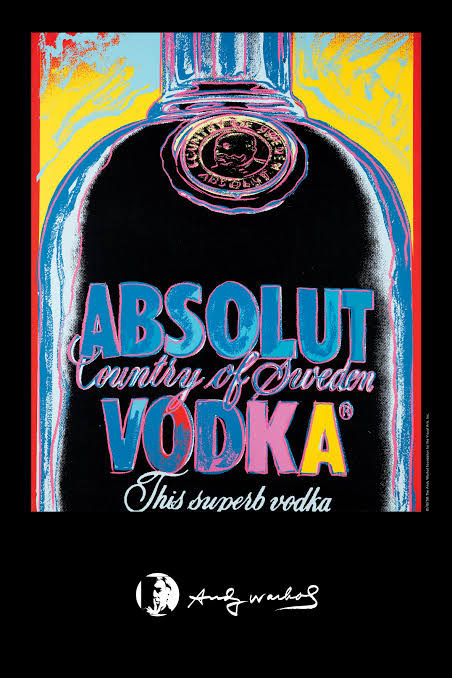
From this approach, genuine commercial partnerships would emerge, almost as a matter of course. According to several corroborating accounts, it was at Studio 54 that Warhol reportedly spotted the silhouette of the Absolut Vodka bottle and suggested to its American importer, Michel Roux, that they “do something” with it. This encounter led to the creation of the painting *Absolut Warhol* in 1985, followed in 1986 by a structured program: the brand began commissioning artists to create works based on the silhouette of its bottle, an initiative that would result, over the following decades, in more than 800 works and the involvement of hundreds of emerging and established artists.
Warhol’s influence extended far beyond his own collaborations. He encouraged those close to him—Keith Haring and Kenny Scharf foremost among them—to explore this path of commercial partnerships as well. And his encounter with Jean-Michel Basquiat in the early 1980s would itself stand as a milestone in the history of the dialogue between art and mass culture.
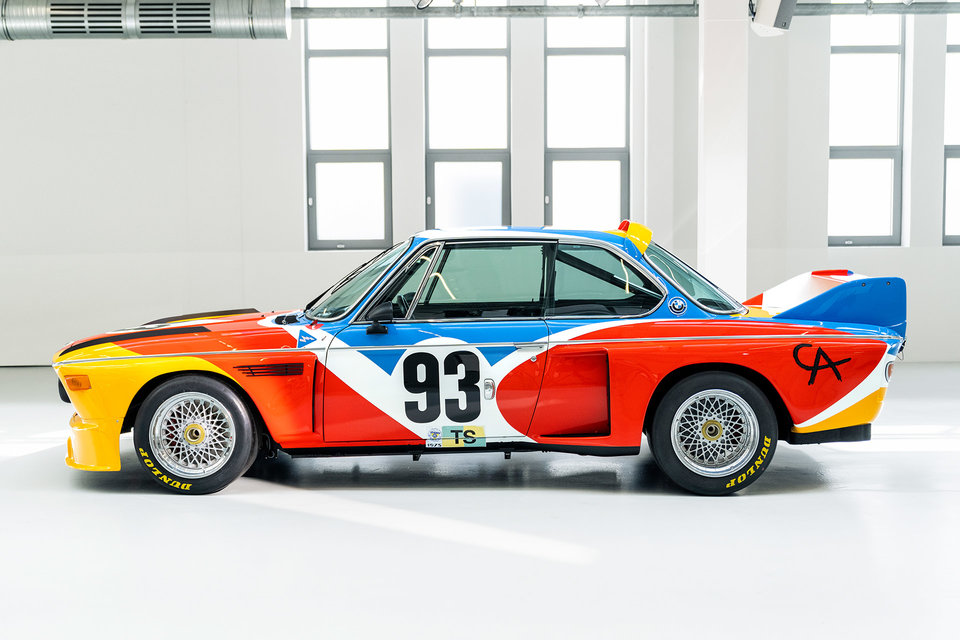
In 1975, French auctioneer and race car driver Hervé Poulain had an idea that, on paper, seemed almost absurd: to invite an artist to paint directly onto the body of a race car. He drew inspiration from a previous project led by Alexander Calder, who had painted an airplane for Braniff International, and asked him to decorate a BMW 3.0 CSL intended to race in the 24 Hours of Le Mans. Calder agreed and applied broad swaths of primary colors directly to the metal.
The car will not finish the race. But it marks the beginning of a collection that now includes twenty “rolling works of art,” created over the decades by Andy Warhol, Roy Lichtenstein, Jeff Koons, and, more recently, Julie Mehretu. This example illustrates a principle that Studio Artera regularly encounters in its own projects: an artist-brand collaboration does not need to result in a marketable object to create value. Calder’s BMW was never put up for sale, yet over the course of fifty years, it has built a unique brand identity at the intersection of contemporary art and motorsports.
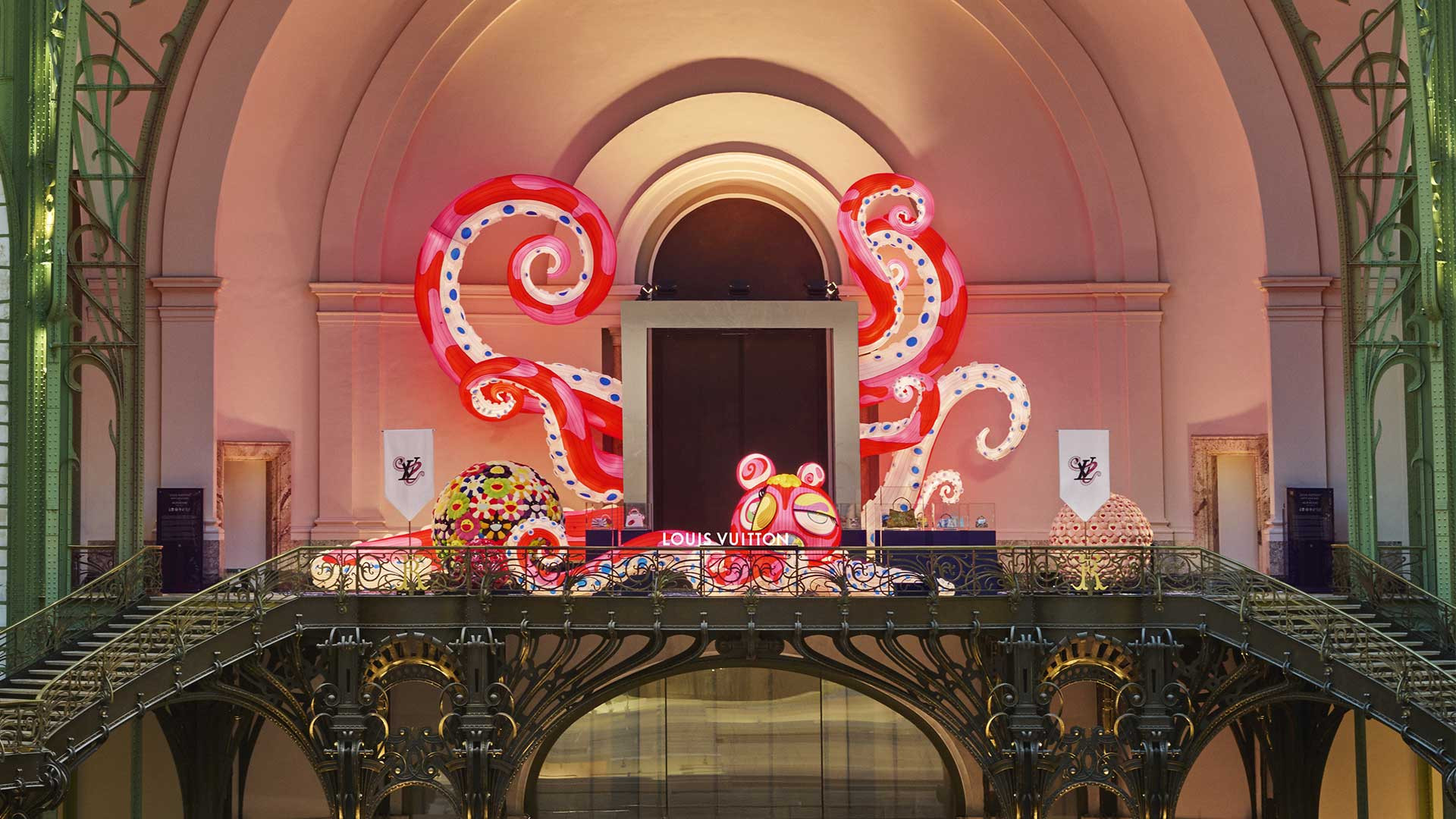
In 2003, under the leadership of Marc Jacobs, then creative director of Louis Vuitton, the house took a risk that seemed considerable at the time: entrusting Japanese artist Takashi Murakami with the task of reinterpreting its historic monogram, one of the most closely guarded assets in the entire luxury industry. Unveiled at the Spring/Summer 2003 fashion show, the result gave rise to the Monogram Multicolore, followed two years later by the Cherry Blossom pattern, and then in 2008 by the Monogram Camouflage.
The gamble paid off—and then some: for the first time, a century-old fashion house relinquished exclusive creative control over its most sensitive asset, and the public embraced it. The commercial and critical success was such that the collaboration continued for several years and kept resurfacing regularly, culminating in a new collection presented at Art Basel Paris with the installation Artycapucines VII, twenty-two years after the two houses first met.
Since then, most major luxury groups have established their own programs of recurring artistic collaborations—a trend that Studio Artera now supports for its clients by sourcing artists and developing customized programs. Our comprehensive approach is detailed in this guide to selecting an artist for your brand.
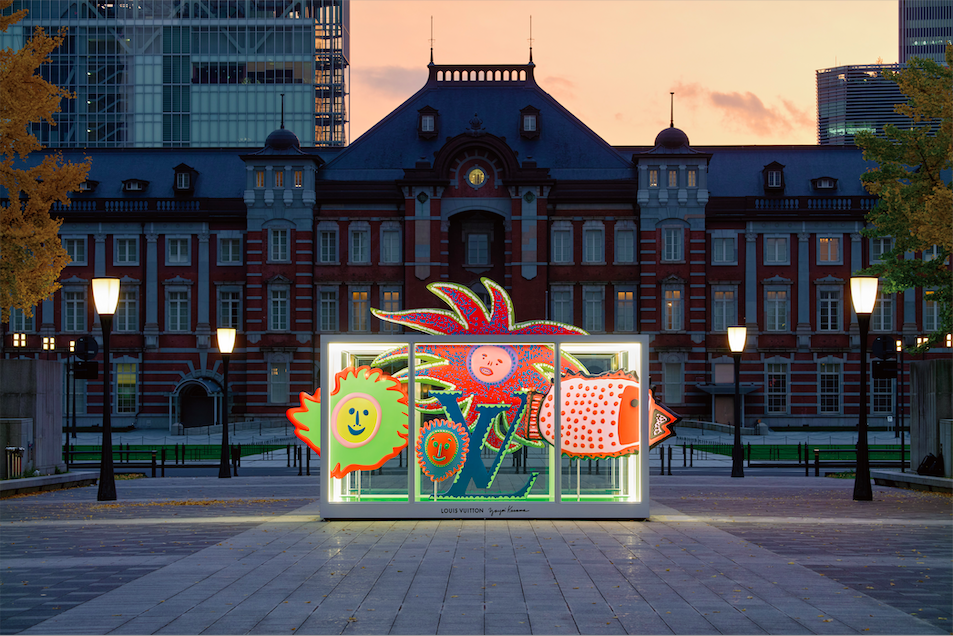
While Murakami paved the way in 2003, it is the partnership between Louis Vuitton and Japanese artist Yayoi Kusama that best illustrates what an artist-brand collaboration becomes when it is built on the long term rather than the here and now. The first chapter began in 2012, spearheaded by Marc Jacobs, who had visited the artist’s studio in Japan as early as 2006 before bringing the project to fruition six years later, on the occasion of a retrospective dedicated to Kusama at the Whitney Museum in New York. The fashion house then adorned its bags and ready-to-wear pieces with the artist’s famous hand-painted polka dots in a collection called Dots Infinity.
Ten years later, in January 2023, under the artistic direction of Nicolas Ghesquière, Louis Vuitton relaunched the collaboration on an unprecedented scale: more than 400 pieces, a unisex collection for the first time, and a spectacular global rollout, featuring storefronts covered in giant polka dots in Tokyo, Paris, London, and New York, all the way to hyperrealistic mannequins of the artist herself displayed in store windows. Titled “Creating Infinity,” this second collection draws directly from Kusama’s broader universe: her “Infinity Mirror Rooms,” first unveiled in 1965, and her “Narcissus Garden” installation, presented at the Venice Biennale in 1966, notably inspired the metallic spheres that accompany the painted motifs.
What this second chapter demonstrates—beyond its sheer scale—is the value of a renewed collaboration: ten years after the initial launch, the original 2012 pieces are fetching high prices on the secondary market, and Kusama’s return in 2023 builds on this cultivated rarity to heighten public anticipation rather than starting from scratch. It is the same mechanism of loyalty and recurrence that has been seen at Mouton Rothschild since 1945 and at Absolut since 1986, this time applied on the scale of a global luxury group.
Starting in the 2000s, a third model emerged, driven this time by streetwear: the collaboration as an event in and of itself, with its own timeline (the “drop”), its own engineered scarcity, and its own community of collectors ready to line up at dawn.
The partnership between Supreme and the artist KAWS is undoubtedly the most representative example of this. Their relationship began modestly in 2008 with a T-shirt celebrating the 10th anniversary of the Supreme store in Daikanyama, Tokyo, and continued for more than a decade, culminating in the highly anticipated release of the “Chalk Logo” hoodie in 2021. At the same time, KAWS has been involved in numerous collaborations, including with Nike, Dior, Comme des Garçons (alongside Pharrell Williams in 2014), and Hennessy, for whom he designed a limited-edition cognac bottle in 2011.
Uniqlo has taken this approach even further by establishing, as early as 2004, an ongoing program of artistic collaborations under its UT line: Andy Warhol since 2004, KAWS since 2016, and then Keith Haring and Jean-Michel Basquiat in 2020. In 2024, a joint KAWS and Warhol collection brings the cycle that began forty years earlier full circle, in a sense, echoing the exhibition of the same name presented at the Andy Warhol Museum in Pittsburgh, with proceeds supporting the philanthropic work of the Andy Warhol Foundation.
The lesson this model offers any brand looking to get involved can be summed up in one sentence: collaboration is no longer a one-off event, but a program designed to create a regular rendezvous with an audience that looks forward to it every season, just as one would look forward to the release of a new album.
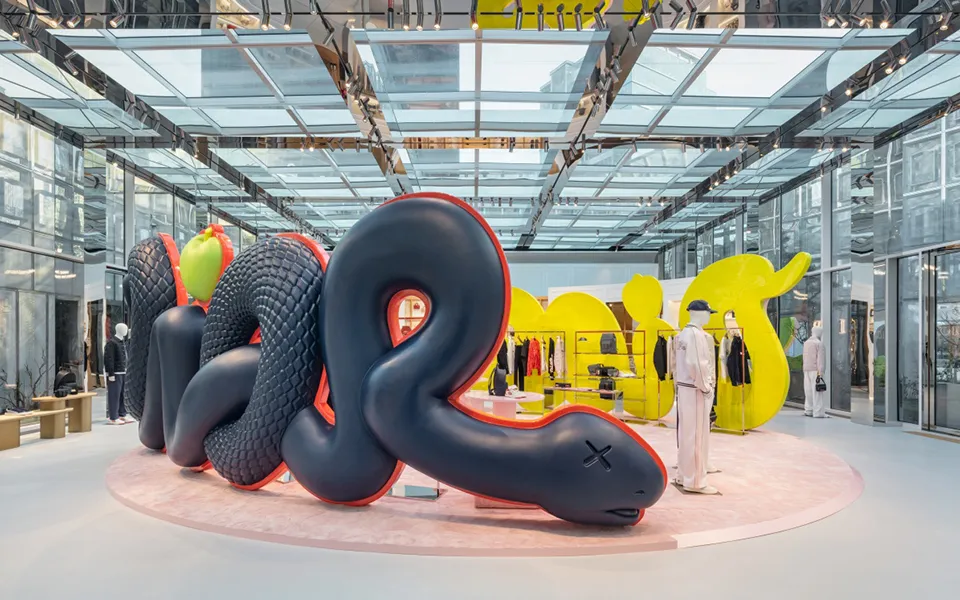
When we take a step back and look at a century of collaborations, four constants emerge, regardless of the sector in question.
First and foremost, the artist’s creative freedom is never negotiable. From Mouton Rothschild to Murakami and Kusama, each example cited above is based on the artist being given carte blanche, not on simply providing visual design for a pre-written marketing brief. Second, consistency builds value: a one-off collaboration makes for a good PR stunt, but it is a long-term program—such as Mouton Rothschild since 1945, Absolut since 1986, Uniqlo UT since 2004, the BMW Art Car since 1975, or Vuitton x Kusama since 2012—that builds a true brand asset. The choice of artist, too, must come before the brief rather than the other way around: in all the historical cases documented here, the meeting between the brand and the artist precedes the definition of the final product. Finally, the object does not need to be commercial to have value. A BMW Art Car has never been mass-produced, yet it has generated fifty years of brand value: the collaboration can take the form of an exhibition, a limited edition, an installation, or an object sold on a large scale; the format is chosen based on the objective, not the other way around.
At Studio Artera, we draw on this history to develop projects tailored to today’s world: sourcing artists who align with your brand identity, establishing the legal and creative framework for the partnership, producing the artwork or edition, and managing its activation and distribution. We support luxury houses, major corporations, and cultural institutions in designing these collaborations, working with nearly 20 artists under our representation.
The formats we produce are as varied as history itself: a monumental fountain, a trade show booth, a series of portraits, a pop-up exhibition. What remains constant from one project to the next is the conviction that has run through this entire story for a century: a successful collaboration stems from an encounter, not a commission.
Would you like to develop your own artist-brand collaboration program?
👉 Check out our brand and corporate projects
👉 Discover the artists we represent
👉 Let's discuss your project
The oldest and best-documented example is that of Château Mouton Rothschild, which commissioned poster artist Jean Carlu as early as 1924 to design its label, before establishing the practice on a permanent basis starting in 1945 with artist Philippe Jullian.
Warhol was the first to turn the consumer product itself into an artistic subject (the *Campbell's Soup Cans*, 1962), before collaborating directly with brands such as Absolut Vodka starting in 1985. In doing so, he paved the way for the generation of artists who followed him, from Keith Haring to KAWS.
The collaboration between Louis Vuitton and Japanese artist Takashi Murakami, launched in 2003 under the leadership of Marc Jacobs, is regarded by the industry as the turning point that led the luxury sector toward structured and recurring artistic collaborations.
The first chapter dates back to 2012, spearheaded by Marc Jacobs. Ten years later, in January 2023, Louis Vuitton is relaunching the partnership on an unprecedented global scale under the artistic direction of Nicolas Ghesquière, with the “Creating Infinity” collection—one of the most extensive artist-brand collaborations ever undertaken by a luxury house.
No. The BMW Art Car program, launched in 1975 with Alexander Calder, never led to mass production; nevertheless, it has built a lasting brand identity over the past fifty years.
Specialized agencies such as Studio Artera assist luxury brands, major corporations, and cultural institutions with artist sourcing, creative and legal structuring, and the production of customized collaborations.


