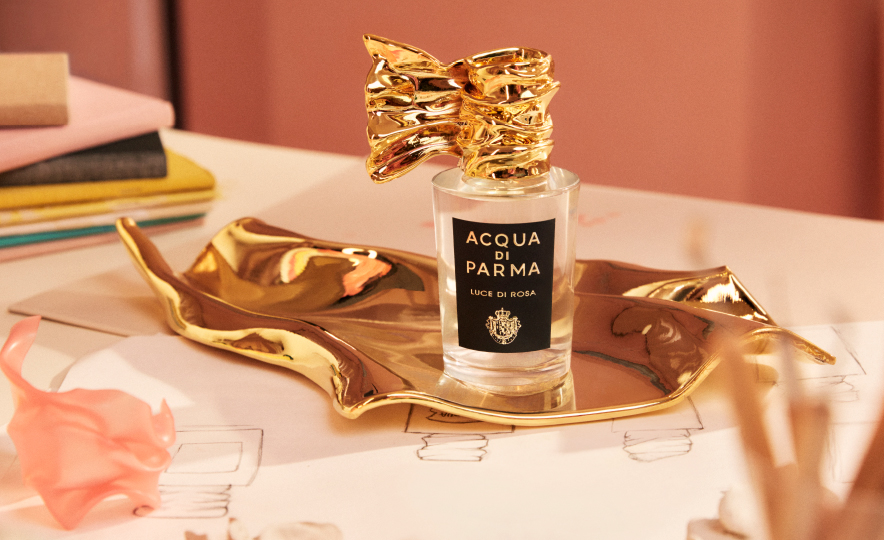
In 1853, Guerlain created the “Flacon aux Abeilles” (Bottle of Bees) for the Eau de Cologne Impériale, a gift to Empress Eugénie. More than 170 years later, this bottle—adorned with 69 bees—continues to serve as a canvas for guest designers, most recently the haute couture embroidery atelier Baqué Molinié. Acqua di Parma, for its part, commissioned sculptor and jewelry designer Annelise Michelson to design the cap for its Luce di Rosa fragrance. In the world of cosmetics, artistic collaboration is first and foremost expressed through the object the customer holds in their hands: the bottle, the packaging, and the gift set.
At Studio Artera, an agency specializing in collaborations between contemporary artists and brands, we closely follow the trends in this sector, which offers a particularly concrete platform for artistic collaboration.
Unlike other sectors where artistic collaboration requires a dedicated physical space (store, venue, event), the cosmetics industry already has a ready-made medium for a designer’s work: the product bottle or packaging. This medium has an advantage that a campaign visual does not, as it is kept—placed on a vanity table—and sometimes collected even after it is empty. This longevity explains the proliferation of limited-edition artist collaborations in this sector, ranging from mass-market to ultra-luxury brands.
Every year, Guerlain reimagines its Bee Bottle in limited-edition, numbered releases—its “Pièces d’Exception”—created in collaboration with artists and master craftsmen. To mark the bottle’s 170th anniversary in 2023, artist Céline Cléron has created a garden of flowers and insects around it, crafted from porcelain biscuit and accented with gold, while jewelry designer Begüm Khan has, on several occasions, transformed it into a piece of jewelry.
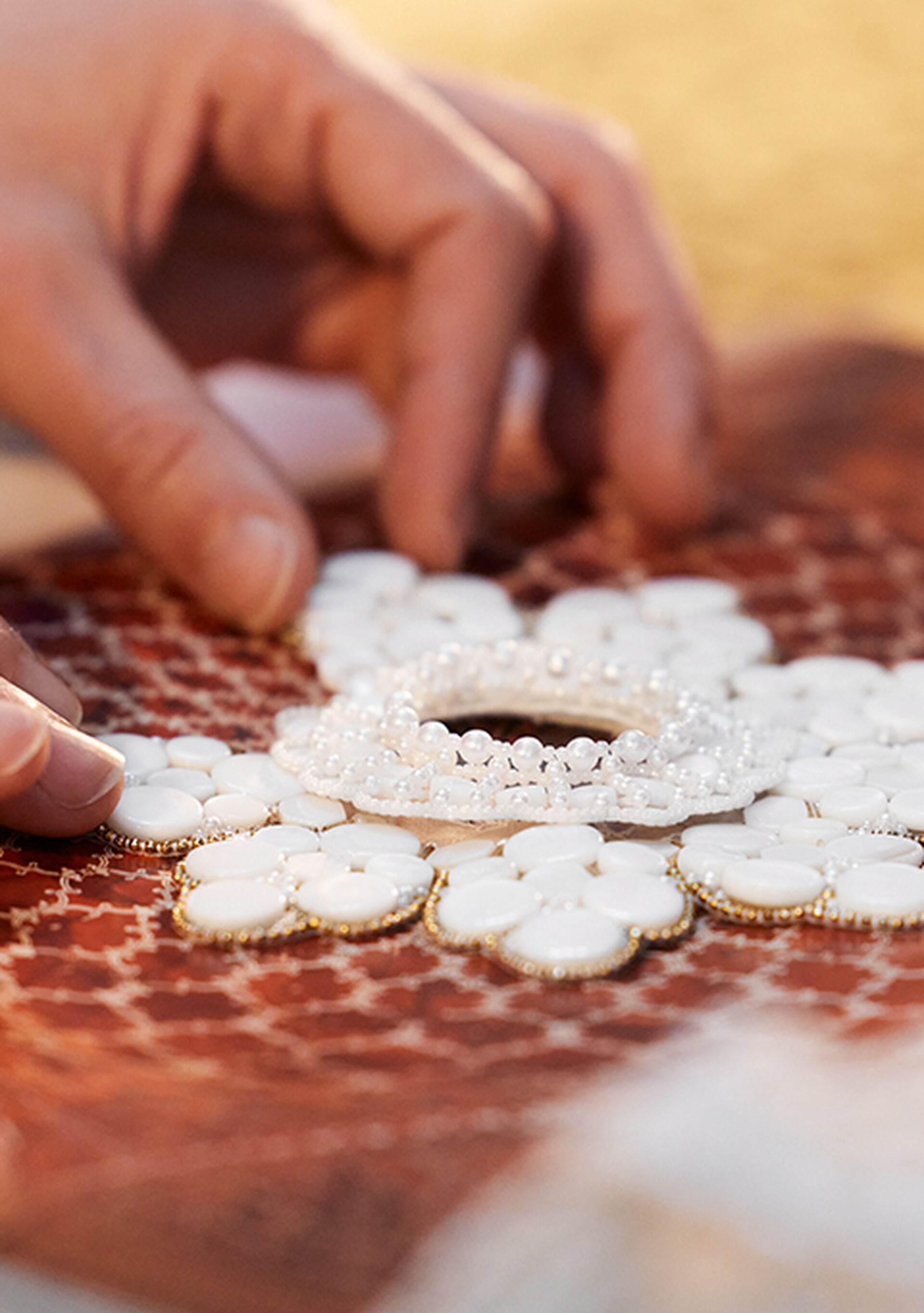
To celebrate Eid, the house turned to Baqué Molinié, an embroidery atelier founded in 2018 by Laetitia Baqué and Victor Molinié, which works for leading haute couture houses. The atelier adorned the dome of the bottle with an entirely hand-embroidered design, crafted from mother-of-pearl beads and moonstone cabochons, with motifs inspired by the dome of the Alhambra and the muqarnas ceilings of Arab architecture. The piece houses an exclusive fragrance, Perle Impériale.
Launched in 2024 as part of the Signatures of the Sun collection, Acqua di Parma’s Luce di Rosa fragrance is accompanied by two Masterpiece objects designed by Annelise Michelson, a French sculptor and jewelry designer. The first is a gold-plated brass cap designed to resemble a drape that envelops the top of the bottle, giving it the appearance of a sculptural object. The second is a matching tray, which extends the collaboration beyond the product itself, into the bathroom or onto the vanity.
These examples show that, in the cosmetics industry, the term “artistic collaboration” refers to approaches that have very little in common. With Baqué Molinié, Guerlain highlights artisanal craftsmanship applied to its bottle design; with Annelise Michelson, Acqua di Parma selects a designer who bridges the worlds of sculpture and jewelry; with Céline Cléron, Guerlain invites a visual artist to create a one-of-a-kind piece. For a brand, the real question at the outset therefore has less to do with the medium than with the creator’s profile and what the brand wants to convey through them. Our guide to choosing an artist for your brand details the criteria that help make that decision.
A collaboration limited solely to packaging risks becoming nothing more than a superficial marketing ploy if it isn’t accompanied by a genuine narrative about the designer and their creative process. The most successful collaborations in this sector pair the product with editorial and digital content that highlights the artist’s work—not just the final result. This is precisely what Guerlain and Acqua di Parma do, dedicating a page to each of these pieces that describes the designer’s studio, technique, and intent. The fashion and luxury sectors have long applied this approach, as we demonstrate in our article on fashion and luxury collaborations.
Are you planning an artistic collaboration for your cosmetics or beauty brand?
👉 Check out our brand and corporate projects
👉 Discover the artists we represent
👉 Let's discuss your project
Unlike other industries that require a dedicated physical space, the cosmetics industry already has a medium through which designers can express themselves: the product bottle or packaging. This medium is kept and sometimes collected, which encourages the proliferation of limited editions.
Guerlain commissioned the haute couture embroidery workshop Baqué Molinié to reimagine its "Flacon aux Abeilles" as a limited-edition, numbered "Métier d'Art" piece. The dome of the bottle is adorned with hand-embroidered mother-of-pearl and moonstones, inspired by the dome of the Alhambra.
Acqua di Parma commissioned French sculptor and jewelry designer Annelise Michelson to create a gold-plated brass jewelry-style cap and a matching tray for its Luce di Rosa fragrance, launched in 2024.
No. A collaboration limited solely to packaging risks becoming nothing more than a superficial marketing campaign. The most successful collaborations combine the product with a genuine editorial narrative centered on the designer and their creative approach.