B2B Strategy Guide · Reading time: 7 min
Art in the corporate world is no longer just about corporate philanthropy or decorating the lobby. For CMOs building sustainable brands, contemporary art has become a strategic differentiator in its own right—provided it is integrated methodically, consistently, and with the right partner.
This guide outlines four practical ways to integrate art into a brand strategy, illustrated by real-world collaborations orchestrated by Studio Artera. It concludes with a five-question self-assessment to help you evaluate where your brand stands.
Brands are facing three simultaneous challenges that traditional marketing tools struggle to address.
The first is channel saturation. Consumers, B2B decision-makers, and potential employees are exposed to such a volume of advertising messages that avoiding them has become second nature. Capturing attention has become the scarcest—and most expensive—resource in marketing.
The second is a lack of trust in brand messaging. Value propositions, CSR charters, and brand manifestos have become genres in crisis. What convinces people today are visible actions, proof through action, and aesthetic and cultural choices that signal a worldview rather than simply stating it.
The third is the demand for experience. Stakeholders (customers, employees, investors, partners) no longer want to simply consume a brand. They want to experience it. Art is one of the few tools capable of creating emotionally charged experiences on a reasonable budget.
It is against this backdrop that the collaboration between contemporary artists and brands has undergone a profound transformation. It is no longer an act of patronage or a symbolic expense, but a strategic decision: choosing an artist whose approach resonates with the brand’s DNA, and working together to create something unlike anything else.
No matter how carefully crafted a visual identity may be, it remains a convention. It can be imitated, adapted, or reinterpreted. An artistic collaboration, however, produces something fundamentally different: a singularity that stems from a unique creative process and cannot be copied because it bears the mark of an artist, not a trend.
Incorporating an original work into a visual identity (packaging, capsule collection, campaign) gives the brand a signature that no one else can claim. And it transforms every touchpoint into a source of desire.
The starting point is never “which artist should we choose?” but rather “what is the creative tension at the heart of our brand?” What value do we want to highlight? What emotion do we want to evoke? What kind of relationship do we want to build with our audience?
It is only after this semantic analysis that connecting with the right artist—one whose visual language resonates with the brand’s DNA—makes sense. Studio Artera always starts there: strategic listening before the artistic proposal.
When Ami Paris approached Studio Artera for the opening of its new flagship store in the heart of the Marais, the brief was clear: not a decorative piece, but a creation capable of reflecting the brand’s DNA, its intimate connection to Paris, and the spirit of a vibrant, elegant, and sometimes unexpected neighborhood.
Studio Artera collaborated with illustrator Émilie Ettori on a bespoke project; her precise yet exuberant style resonates naturally with the world of Ami. This collaboration gave rise to a large illustrated map of the Marais—a neighborhood waiting to be explored, an urban tapestry where architecture, fleeting figures, and Parisian poetry intertwine.

The campaign was designed with a dual purpose: to provide Ami Paris’s digital channels with compelling, narrative-driven visual content, while also being displayed in the flagship store and shared with partner retailers in the neighborhood. It’s a piece that tells the brand’s story without ever mentioning its name.
Corporate events (conferences, client receptions, trade show activations) share a common flaw: they are indistinguishable in the minds of those who attend. People don’t remember the keynote speaker’s name, the cocktail menu, or the layout of the booths. What sticks with them is what sparked an emotion.
However, most corporate events aren’t designed to evoke emotions. They’re designed to convey information, represent a brand, or foster networking. These are legitimate goals, but they don’t explain why people remember certain moments and forget others.
When integrated into an event, art transforms the nature of the experience. It creates a sense of wonder, draws the eye, and sparks conversation. It gives participants something to photograph, share, and comment on—spontaneously, without the brand having to ask for anything.
For the past 23 years, NetJets, the global leader in fractional business aviation, has partnered with Art Basel to offer its clients an immersive experience at the heart of the world’s largest contemporary art fair. For this edition, NetJets gave artist Silvère Jarrosson carte blanche to design the signature look of its lounges in Basel, Paris, and Miami.
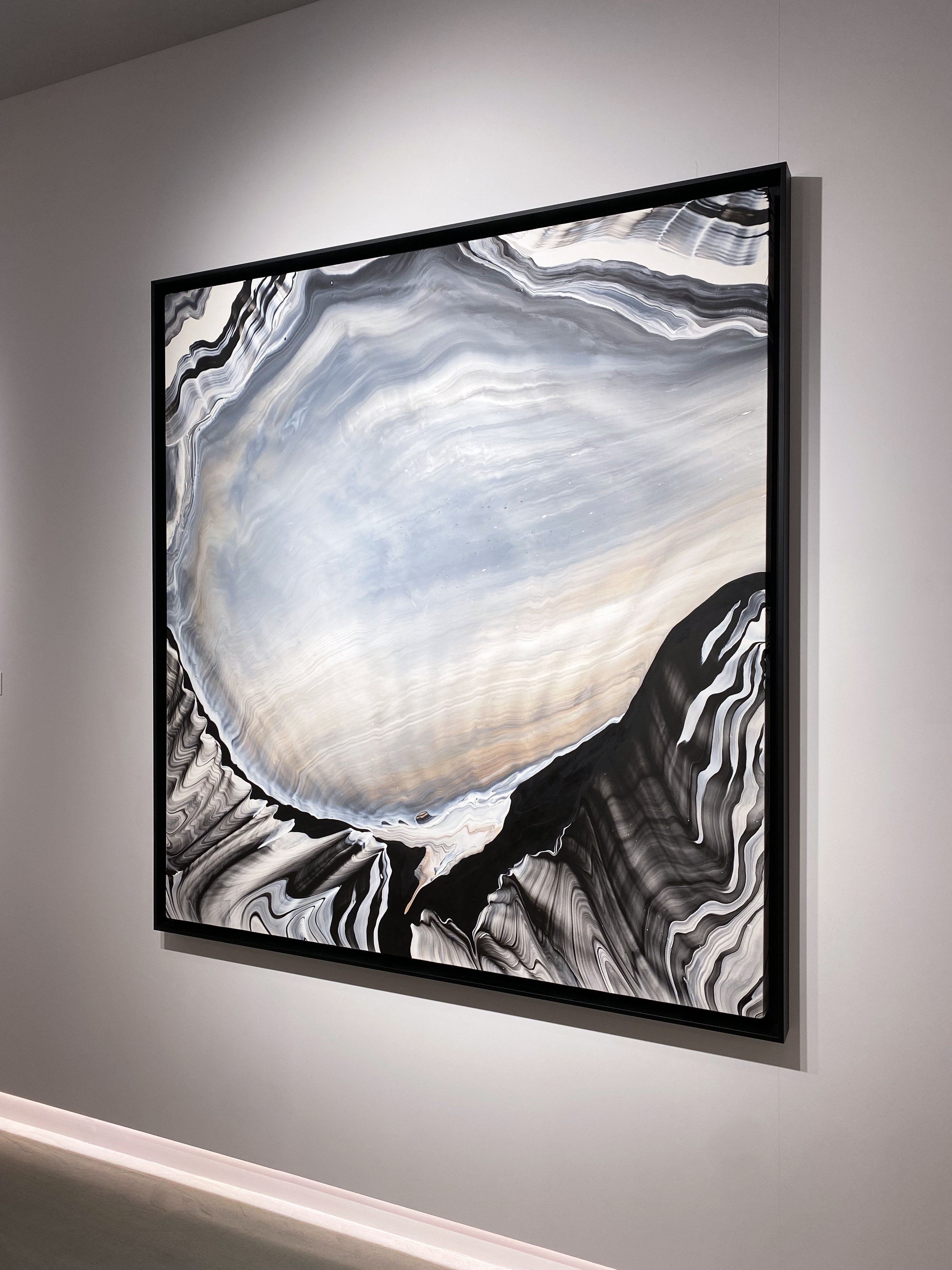
Silvère Jarrosson conceived the exhibition *Inner Horizons*, a pictorial odyssey exploring the definitions of travel—both physical and sensory. The lounges, spanning several hundred square meters, have been transformed into timeless settings, blending the experience of physical travel made possible by NetJets with the inner journey created by painting.
The corporate headquarters, the showroom, the store, and the client meeting room: these are spaces where the brand speaks constantly, without saying a word. What they convey—or what they don’t convey—shapes the perceptions of employees, customers, partners, and job candidates.
The fundamental distinction is between placing art in a space and designing a work for a specific space. A piece purchased from a gallery is beautiful. A work commissioned by Studio Artera for a specific context, in dialogue with the company’s history and values, is narrative: it tells a story that nothing else in the space conveys.
For Sopra Steria’s 2025 Kick-Off, a strategic event that brought together more than 1,000 top managers from around the world at the Palais des Congrès in Paris, the goal was not simply to fill the space visually, but to broaden the scope of strategic discussions through art.

Studio Artera proposed a collaboration with Léo Caillard, an artist known for his works that blend classical references with digital anachronisms. This visual language resonated directly with Sopra Steria’s core belief: that digital transformation is a cultural continuum, not a rupture.
Branded content is one of the most expensive and thankless investments in modern marketing. It consumes considerable resources and often has a very short shelf life. Most content produced by brands is viewed, forgotten, and replaced.
An artistic collaboration reverses this dynamic. It produces content that is intrinsically rich, visually distinctive, narratively dense, and culturally authentic—content whose value endures over time.
A common mistake is to treat communication as a final step, coming after the project. Studio Artera integrates it as a cornerstone of the design process from the very beginning. The timeline of the project—from the initial commission through the creative process to the final presentation—is itself part of the content.
For the 2024 edition of VivaTech, Europe’s largest tech trade show with 650,000 visitors, Studio Artera showcased the works of Florian Zumbrunn. It was a deliberately counterintuitive choice: at a trade show where everything revolves around digital disruption, to feature an artist who bridges the gap between machine and human touch, code and physical matter.

A Franco-Swiss artist born in 1987, Florian Zumbrunn designs the algorithms he uses to generate his images himself, before reworking each piece by hand with dry pastels and oil sticks. This interplay between calculated abstraction and intuitive gesture produces familiar, almost contemplative mental landscapes that created a very distinctive tension within the overstimulating environment of VivaTech.
A service provider offers you a selection of artists to choose from. Studio Artera begins by analyzing your brand DNA, your business objectives, your target audiences, and your competitive positioning before recommending the most strategically sound collaboration.
The brands that work with Studio Artera (Louis Vuitton, Christie’s, Paris Saint-Germain, Prada, Amazon Web Services, NetJets, AMI Paris, Sopra Steria, VivaTech, Maison Margiela) build brands that have something to say.
Five questions. Answer honestly. Every “no” is an opportunity.
1. Differentiation
Can you describe in one sentence what visually and emotionally sets your brand apart from your three main competitors?
If not: your brand identity lacks a distinctive edge.
2. Engagement
Do your events and branded content naturally generate shares and conversations, even without a promotional budget?
If not: your content isn’t sparking any emotion.
3. Spaces
Do your physical spaces reflect your worldview, or are they merely functional?
If they’re merely functional, you’re leaving a permanent brand touchpoint untapped.
4. Consistency
Are your stated values reflected in concrete, visible actions?
If not: you risk creating a disconnect between your words and how others perceive your actions.
5. Sustainability
Do your communications investments create brand assets that stand the test of time, or fleeting impressions?
If fleeting: an artistic collaboration produces enduring content that retains its value long after the initial investment.
Would you like to explore how art can transform your brand strategy?
Contact Studio Artera
👉 Explore our brand and corporate projects
👉 Discover the artists we represent


