

.png)

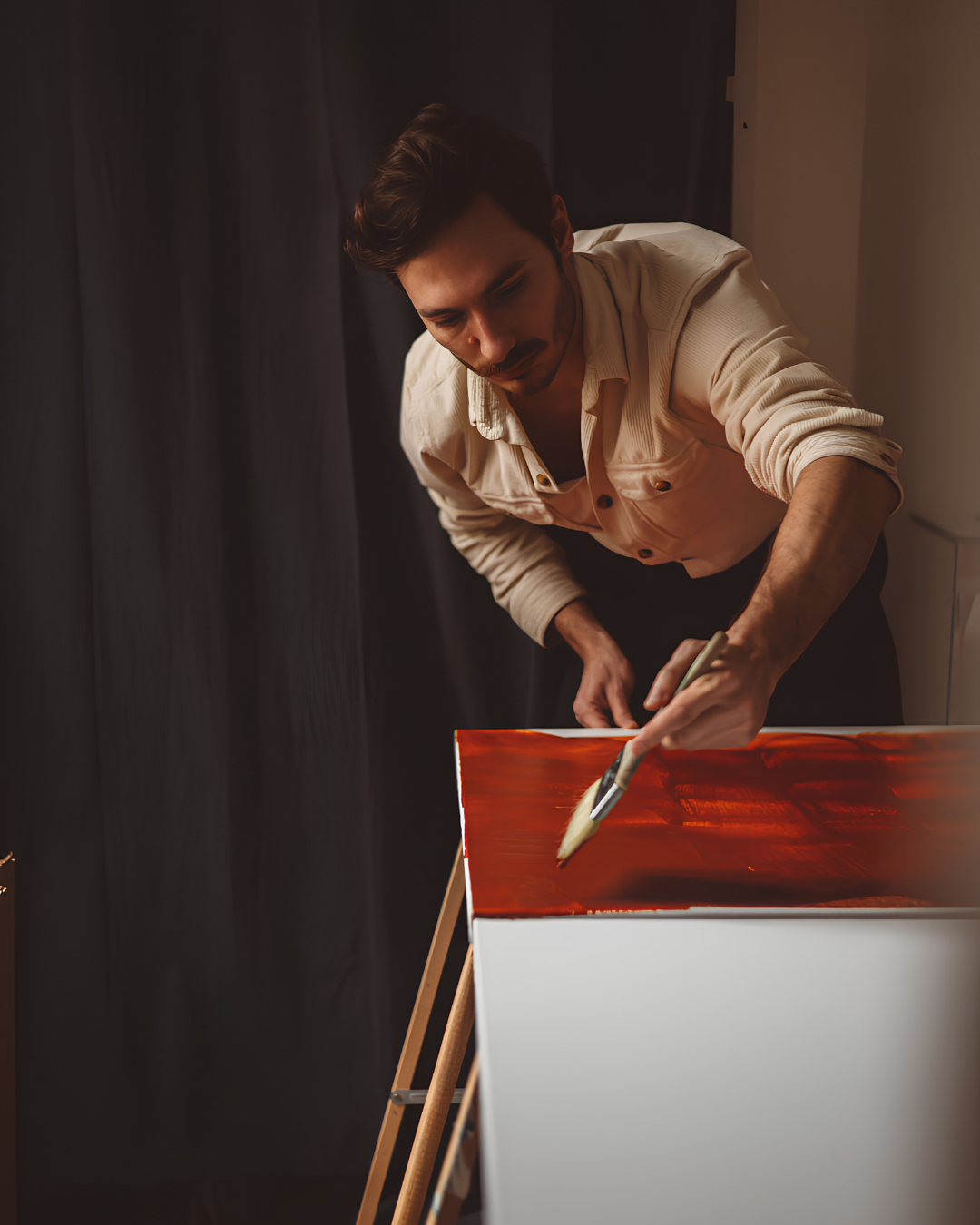
Trained in architecture under Christian Liaigre and Pierre Yovanovitch, Gaultier Rimbault-Joffard embodies a rare approach in which structural rigor serves the raw material. This dual training, spanning both construction and design, has enabled him to develop a unique mastery of media as varied as paint, wood, and metal.
Rather than imposing his vision on the material, as some artists do, Gaultier Rimbault-Joffard chooses to listen. His practice consists of creating the conditions for each material to reveal its own nature, grain, texture, and memory. This precise work is by no means an act of erasure: on the contrary, it is a demonstration of total technical mastery, harnessed to achieve a result that seems natural, almost inevitable.
This requirement has not remained a secret. Gaultier Rimbault-Joffard has aligned his vision with that of leading brands: Louis Vuitton, Orient Express, Tricot, Lafaurie, and Iconic House. These collaborations demonstrate his ability to translate a unique sensibility for materials into objects and environments designed for the most discerning tastes.
Gaultier Rimbault-Joffard’s works cannot be faithfully reproduced on a screen. They require the viewer’s presence, movement, and wandering. Light plays a central role in them: it reveals the material from shifting angles, transforming each piece into a living experience that is renewed depending on the viewer’s perspective.
After exhibiting his work in Europe and the United States, Gaultier Rimbault-Joffard will be an artist-in-residence at the CAB Foundation in 2026.
Her work has been featured in the design press, with articles in AD, Elle Déco, Marie Claire, and Ideat.
Gaultier Rimbault-Joffard’s artistic world is built at the intersection of architecture and raw materials. Trained in the discipline of design, he brings this same attention to invisible structures—to what holds a form together from within—into his visual art practice.
Paint, wood, metal: each medium is treated as a partner in dialogue. It is not a matter of imposing, but of revealing. This demanding and precise act of subtraction produces works whose presence unfolds in time and space, as the viewer moves and the light shifts.


