

.png)

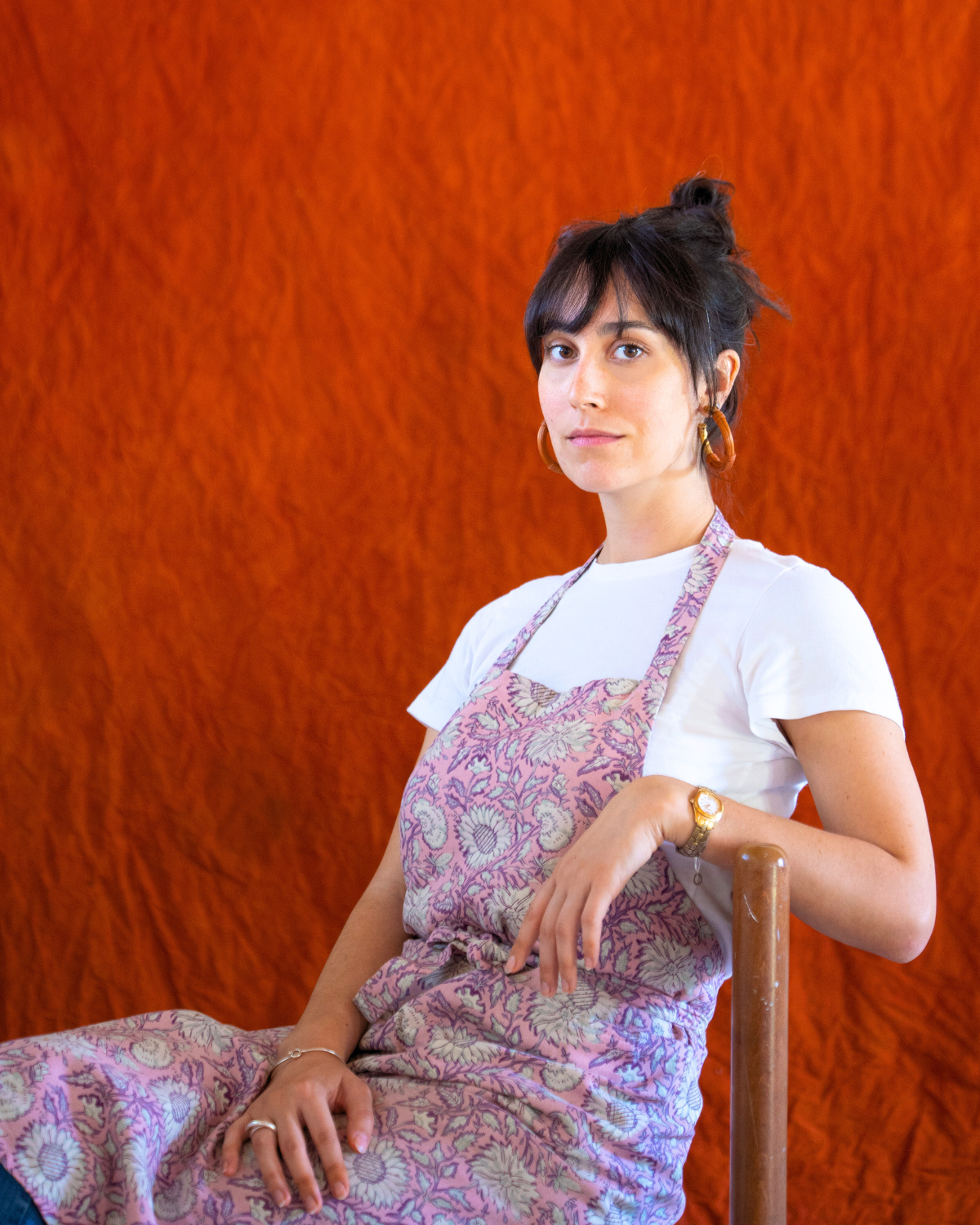
Alice Magne is a visual artist. A graduate of Villa Arson in Nice and based in Lyon, she has spent several years developing a practice that could be described as “slow color,” in direct contrast to the synthetic pigments and digital immediacy that dominate the contemporary art market.
Her signature technique, "bouquet dyeing," involves rolling and steaming the canvas with plants—dahlias, oxalis, and logwood—to extract their chromatic imprint through a combination of pressure and steam. The canvas becomes a receptive skin that captures the invisible pulse of the seasons and the soil. In the view of art critic Julie Chaizemartin, this work resembles a “vegetal Hantaï”: an organic abstraction where the plant acts in place of the painter.
In 2024, Alice Magne won the Art Eco-Design Prize, organized by Art of Change 21 in partnership with the Palais de Tokyo, France’s premier award for artists who incorporate sustainability into their practice. That same year, she won the Art & Nature Prize from the Ulrich Rampp Foundation. Her work has been featured in Vogue Italia, The Art Newspaper, and BeauxArts Magazine, and is included in prestigious private collections across Europe.
Alice Magne's work is an experience of presence. She envisions the canvas as a "receptive skin" capable of capturing the invisible pulse of the earth and the seasons. Her aesthetic, often compared to a form of organic abstraction, transforms fragments of nature into immersive landscapes.
It is not a question of depicting the plant, but of allowing its memory to act on the medium. By working with natural dyes, she places her art within a geological temporality, reminding us that color is a living entity, sensitive to light and the passage of time.


